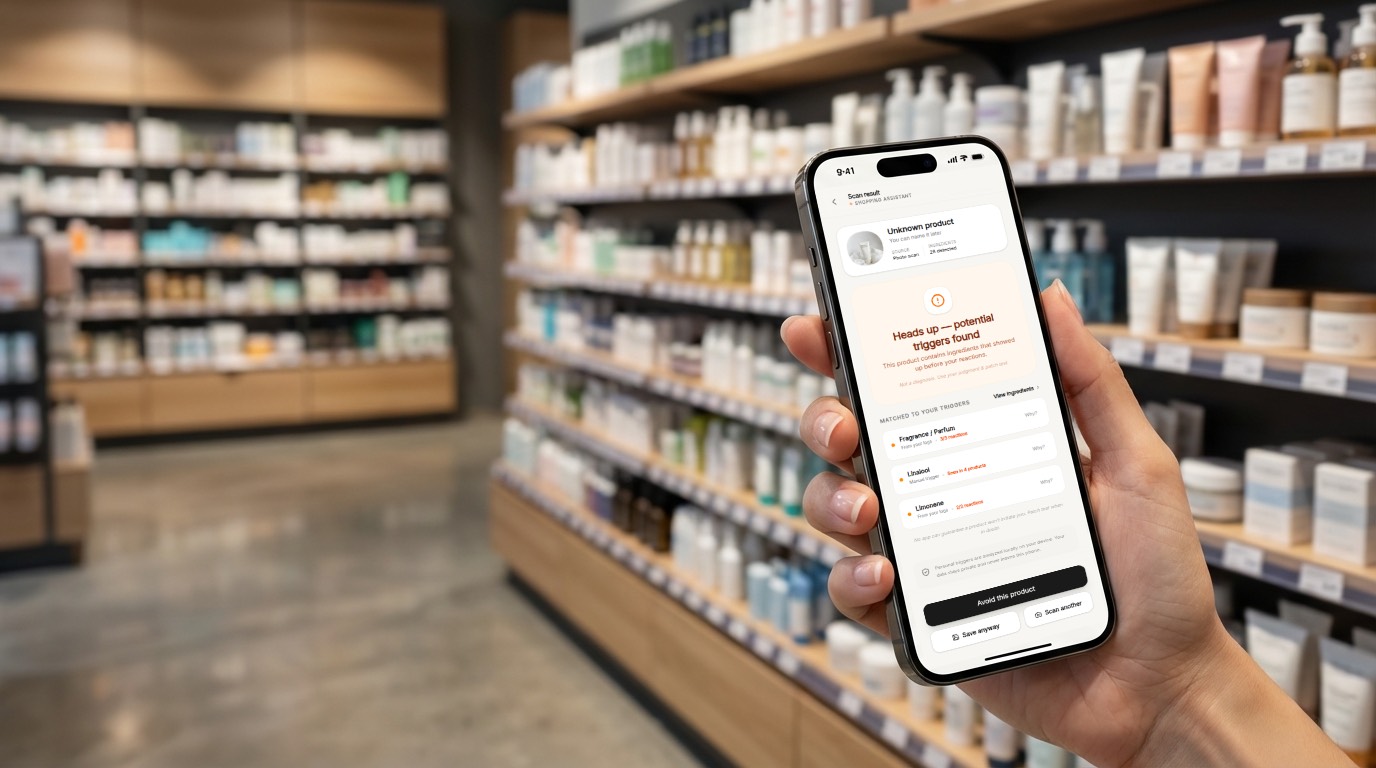
A 60-second ingredient check you can do before buying skincare, so you avoid known triggers, reduce flare-ups, and stop gambling on products.
By Skintrig Team
Skintrig Team publishes practical, privacy-first guides about ingredient tracking and skincare reaction logging.
Buying skincare shouldn’t feel like gambling.
If you’ve ever paid for a “holy grail” product and then spent the next week recovering from irritation or breakouts, you already know the real cost isn’t just money,it’s time, confidence, and a stressed skin barrier.
This post gives you a simple pre-purchase ingredient check you can do in ~60 seconds. It won’t guarantee a product is “safe” (nothing can), but it will dramatically reduce avoidable mistakes,especially once you’ve identified a few personal triggers.
If you haven’t done the trigger-finding method yet, start here: How to Find What’s Causing Your Breakouts (Without Guessing).
Why “buying smarter” beats “buying less”
Most people respond to bad reactions by either:
- buying nothing for months, or
- panic-buying more products to “fix” the reaction.
Neither is great.
A pre-purchase check is the middle path:
- you keep trying products,
- but you stop repeating the same mistakes.
The 60-second pre-purchase check (the exact steps)
Step 1: Know your “Avoid list” (even if it’s tiny)
You don’t need 20 triggers. You need one.
Your avoid list can start as:
- 1–3 ingredients you’ve seen show up repeatedly before symptoms,
- or even one category (e.g. certain fragrance components) if you react fast.
If you don’t have this yet, use the tracking template: Skincare Reaction Tracker Template.
Step 2: Get the real INCI list (not the marketing claims)
Ignore “for sensitive skin”, “non-comedogenic”, “clean”, “dermatologist tested”.
You want the INCI (full ingredient list). Ideally:
- from the box / bottle,
- or the brand site (but those can differ by region or reformulation).
Step 3: Scan for your avoid list (first pass)
Do a fast scan for:
- your known triggers,
- your known trigger categories (if applicable),
- “wildcards” you personally avoid.
If you find a match: skip the product. Don’t negotiate with yourself.
Step 4: Check “new risk” (second pass)
If nothing from your avoid list appears, don’t declare victory.
Ask:
- Is this introducing something you’ve never used before (new active, strong exfoliant, heavy occlusive)?
- Would this stack with something you already use (e.g. acid + retinoid + vitamin C all at once)?
- Is your barrier already stressed?
If the answer is “yes”, treat it as a controlled test: introduce it slowly and change only one thing at a time.
The rule that saves the most skin (and money)
If you’re testing a new product, don’t change anything else for 2–3 weeks.
- Acne/congestion can be delayed.
- Barrier issues can build up.
- “It was fine for 3 days” means almost nothing.
Where an app helps (without changing the method)
You can do the 60-second check manually. The method is simple.
What makes people fail is friction:
- you don’t remember your triggers in the store,
- you can’t quickly compare ingredient overlap across products you reacted to,
- you don’t have the exact INCI saved anywhere.
Skintrig app can make the same workflow effortless:
- store your personal avoid list (based on your history),
- scan/capture INCI once and keep it clean,
- warn you if a product contains your known triggers.
Important: a “No known triggers found” result is not a promise of safety. It’s just a reminder: this product doesn’t match patterns you’ve already identified.
A quick example (how to apply this in real life)
You’re in a store. You see a product that looks perfect.
Do this:
- Open the Shopping Assistant tab in Skintrig app.
- The scan turns the label into a clean, structured list (no copy-paste mess).
- Review the result:
- Matches found → you’ll see exactly which ingredients match your personal avoid list (and why they’re flagged) → skip it.
- No known matches → it doesn’t conflict with patterns you’ve already identified → treat it as a controlled test (change one thing at a time).
- If you buy it, save it to your routine so future reactions link back automatically.
FAQ
Does this work if I don’t know my triggers yet?
Yes, but start with basics: stable routine, track reactions, and build your avoid list over time. The check becomes more powerful as your history grows.
What if the INCI list online is different?
It happens (reformulations, regions). When possible, trust the packaging. If you’re unsure, treat it as a higher-risk test.
Is “fragrance-free” always safer?
Not always. Some people react to fragrance, others don’t. Your history matters more than general rules.
Can one ingredient be fine in one product but not another?
Yes. Concentration, formulation, and combinations matter. That’s why we focus on repeat patterns, not single events.
When should I stop experimenting and see a dermatologist?
If symptoms are severe, painful, widespread, scarring, or persistent, get professional help. This is a tracking method, not medical care.
References
Want these insights in one place?
Join the waitlist to get early access when beta opens (planned for mid to end of March 2026).
Join waitlistRelated posts
-
 What Is an INCI List and How Do You Read It?
 INCI lists are the standardized ingredient disclosures on every cosmetic product. Here's what the naming system means, how ordering works, and what the list can't tell you.
-
 Common irritants in skincare: how to identify and avoid your triggers
 A practical guide to the skincare ingredients that most often irritate sensitive skin, how to read labels more carefully, and how to spot patterns in your own routine without guessing.
-
 How to Find What's Causing Your Breakouts (Without Guessing): A Simple Tracking Method
 A practical method to identify your personal skincare triggers using timing + ingredient overlap,plus how INCI scanning and tracking makes it effortless.